
Finding New Milford Residents
The record you need depends on what you already know. A name, an address, or a year each opens a different trail in New Milford. The Vision property search is the natural first stop. That holds when an address or owner is in hand. The Secretary of the State lookup can verify a registration result. It will not trace an address history, though. A deed index names the recorded parties, not every person under one roof. Older households call for the library, regional directories, maps, newspapers, and the Historical Society. Dated sources carry a time stamp a current roll lacks.
Keep the question sharp before you search. "Who owns this parcel?" points to an assessor card. Then it leads to the Town Clerk land-record index. "Was this person registered?" belongs with the state or local registrar. "Who lived at this address in 1966?" needs a dated directory or telephone book. A result gains real strength when two independent records agree. Match them on a name, a place, and a date.
- Run the known address, owner, account, MBLU, or PID through the Vision property search.
- Compare the parcel point and surrounding map labels in MapGeo, keeping situs and mailing address separate.
- Use the Connecticut voter lookup or New Milford registrar for a registration question, without treating a missing result as proof of nonregistration.
- Search the Town Clerk’s RecordHub index for grantor, grantee, instrument date, and book/page leads.
- For a past household, pair a directory, map, newspaper, or Historical Society item with the dated land trail.
New Milford Record Offices
Records here run municipal first, then state or judicial. At Town Hall, the New Milford Town Clerk keeps land instruments, vital copies, election materials, licenses, trade names, cemetery reports, and meeting records. The assessor describes each parcel and its value. Voter registration and statewide vital guidance sit with state systems. Civil cases move through the Litchfield Judicial District, while estates pass through Housatonic Probate Court.
The names matter. Connecticut has no county clerk acting as land-record recorder today, and Litchfield County survives only as a geographic label. So a deed for a New Milford parcel belongs with the New Milford Town Clerk, even when a search begins with the county name.
New Milford Town Clerk
10 Main Street
New Milford, CT 06776
860-355-6020
None of these offices pool their data into a single roster. Record the keeper and the record type beside every name you collect.
When a defined New Milford record is not available online, the Connecticut Freedom of Information Act guidance lays out the inspection, copying, response, and exemption principles that apply.
FOIA opens a request path to existing records. It does not order an unrestricted list of every person tied to a place.
New Milford Property Record Fields
The Vision Government Solutions portal is the most concrete current address route in New Milford. It takes one search source at a time and returns parcel detail. The road may be known, but the parcel number is not. In that case the street browser earns its keep. MapGeo adds a spatial view of the lot. The assessor card remains the place to read parcel detail. It covers owner, value, building, sale, situs, and mailing fields.
Never normalize a street suffix or unit first. Save the exact source string for any parcel question. The MBLU route is segmented. A partial map, block, lot, or unit value is never a complete parcel identifier on its own.
| Source | Address, Owner, Acct#, Mblu, or PID |
|---|---|
| General value | Address, owner name, account, MBLU, or PID text |
| MBLU parts | Map, Map Cut, Block, Block Cut, Lot, Lot Cut, Unit, Unit Cut |
| Street browse | Alphabet tabs A through Z; no X tab was observed |
| Returned detail | Owner, PID, MBLU, assessment, building facts, sale lead, situs, and mailing address |
The New Milford property search is open to anyone. But a parcel result is ownership and assessment evidence. It does not prove who lives there now.
The public sample makes the gap plain. PID 4829 at 7 Main Street lists New Milford Green LLC as owner. Its mailing address is in Danbury rather than at the New Milford situs. PID 4854 at 10 Main Street is a Town-owned City Hall parcel. Side by side, they show why owner, mailing, and occupant are three different labels.
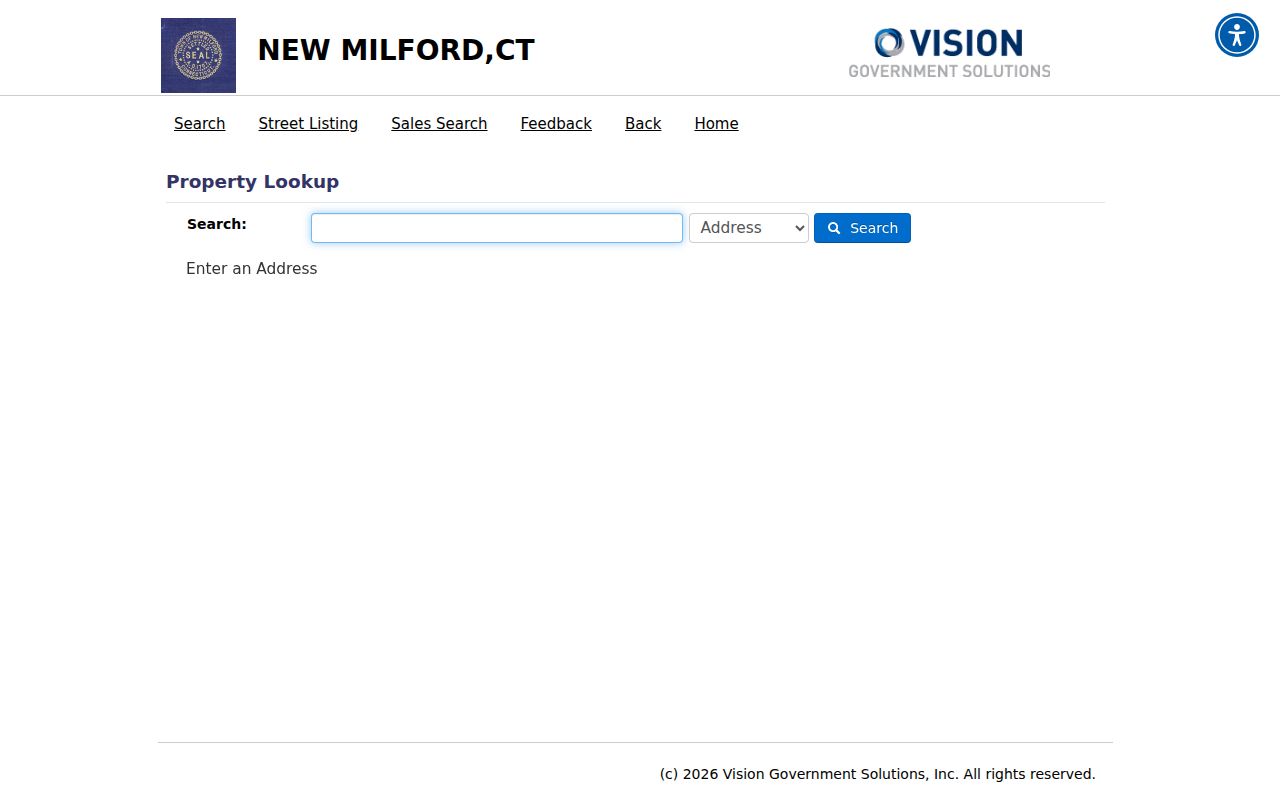
The assessor screen gives a repeatable starting point for a New Milford residents directory search. To walk a whole road, follow the New Milford street directory address chain. Move to the Town Clerk once the question turns on a recorded instrument.
What New Milford Resident Records Mean
A parcel card can describe land, a public building, a business entity, or a mixed-use structure. Typical fields include a PID, MBLU, account, owner, market value, assessment, year built, style, model, use code, sale date, and a book/page lead. Those fields connect an address to the right record family. They do not name every person tied to the property.
PID 4829 offers a useful comparison. It shows a 1905 building and a Stores/Apt style. The entry lists an Ind/Comm model and a 2007 sale lead. It also carries an owner mailing line outside New Milford. PID 4854 describes an 1875 City Hall parcel held by a public owner. The contrast is a local reminder. A residents directory must label entities and public buildings rather than turn any name into a resident claim.
| Field | What It Answers | What It Does Not Answer |
|---|---|---|
| Situs address | Where the assessor places the parcel | Who is inside now |
| Owner | Who the tax or assessment record names | Whether the owner occupies it |
| Mailing address | Where notices are directed | The physical residence of a person |
| Book/page lead | Where a recorded sale may be found | The full deed or current occupants |
Clear interpretation keeps fiscal data, title evidence, map geometry, and household evidence in separate lanes.
Current New Milford Resident Sources
Different records answer different questions about New Milford people. The assessor is the strongest office for a parcel owner. Voter rolls confirm registration status. They also show whatever election-history fields the state permits the public to see. Courts offer a way to follow a case, not a census of who lives where. Vital records prove a life event, and only through the issuing office. No single source lists everyone in a household.
| Source | Keeper | Useful For | Access Caution |
|---|---|---|---|
| Property card | New Milford Assessor | Owner, parcel, mailing and building facts | Not occupancy evidence |
| Land index | Town Clerk / RecordHub | Grantor, grantee, instrument and book/page lead | Online cutoff is not confirmed |
| Voter lookup | Connecticut SOTS and registrar | Registration and defined election history | Privacy and purpose rules apply |
| Court lookup | Judicial Branch | Public party, docket, property-address case route | Coverage and sealed-record limits |
| Vital copy | Town Clerk / DPH | Birth, marriage, or death event | Eligibility, ID, and fee rules vary |
A broad request for every person tied to an address rarely works. Ask the right custodian for something specific instead. That approach gets results far more often than a sweeping demand ever will.
The New Milford Town Clerk records page names the municipal route for land, vital, election, and meeting records.
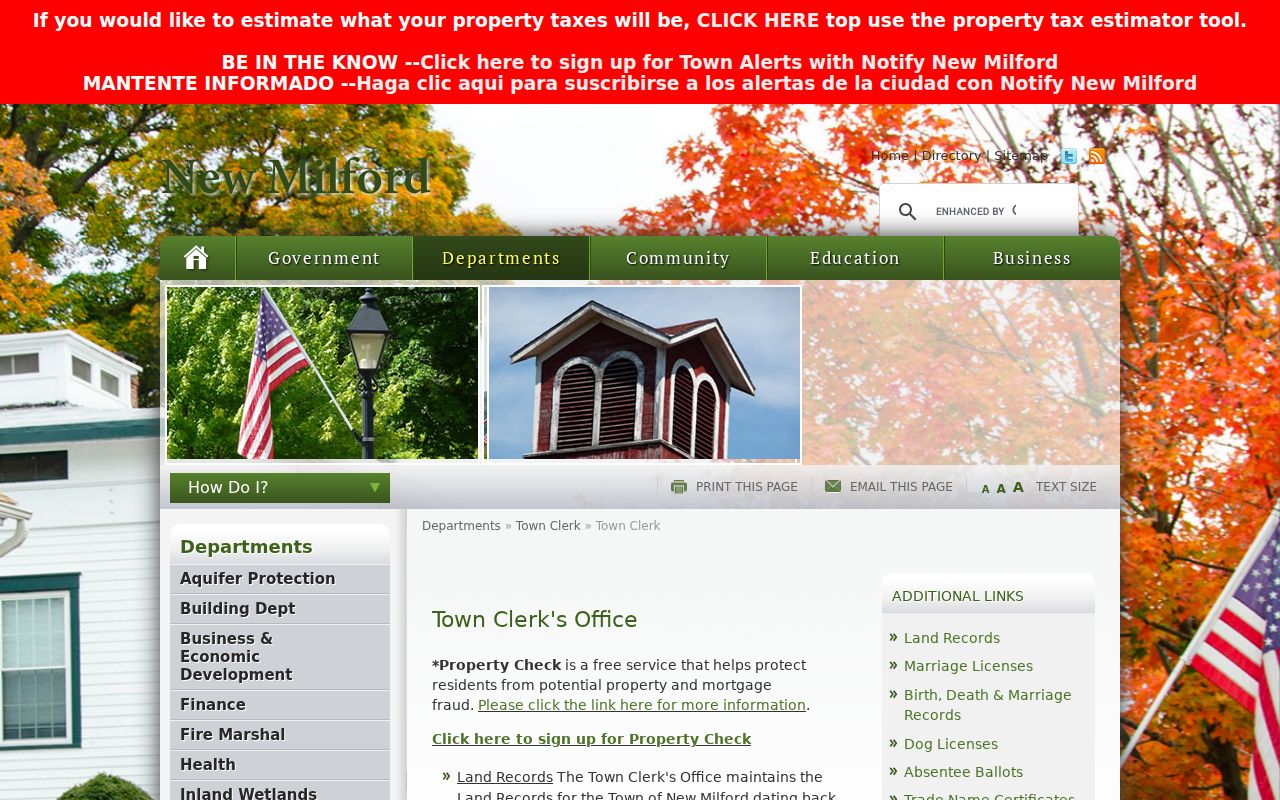
The New Milford RecordHub landing page pulls together land-record search, record requests, subscriptions, and Property Check notifications. Having those tools in one place does not mean every index or image back to 1712 is actually online.
New Milford Voter Record Privacy
Connecticut runs one centralized voter-registration system for all 169 towns, though local registrars keep their own lists. The public lookup is an official status route. It is not an address-history service. Election history gets updated within 60 days. Public Act 26-1 § 96 shields the month and day of birth from the public file while still letting the birth year show.
A bulk voter file is a different animal. The state request form costs $300 and demands an election-related, scholarly, journalistic, political, or governmental purpose. Personal or private use is barred. So are harassment, advertising, solicitation, marketing, and unauthorized reproduction or display. No polling district or missing lookup result can be stretched into a street roster.
For individual registration, the Connecticut voter lookup is the documented route.
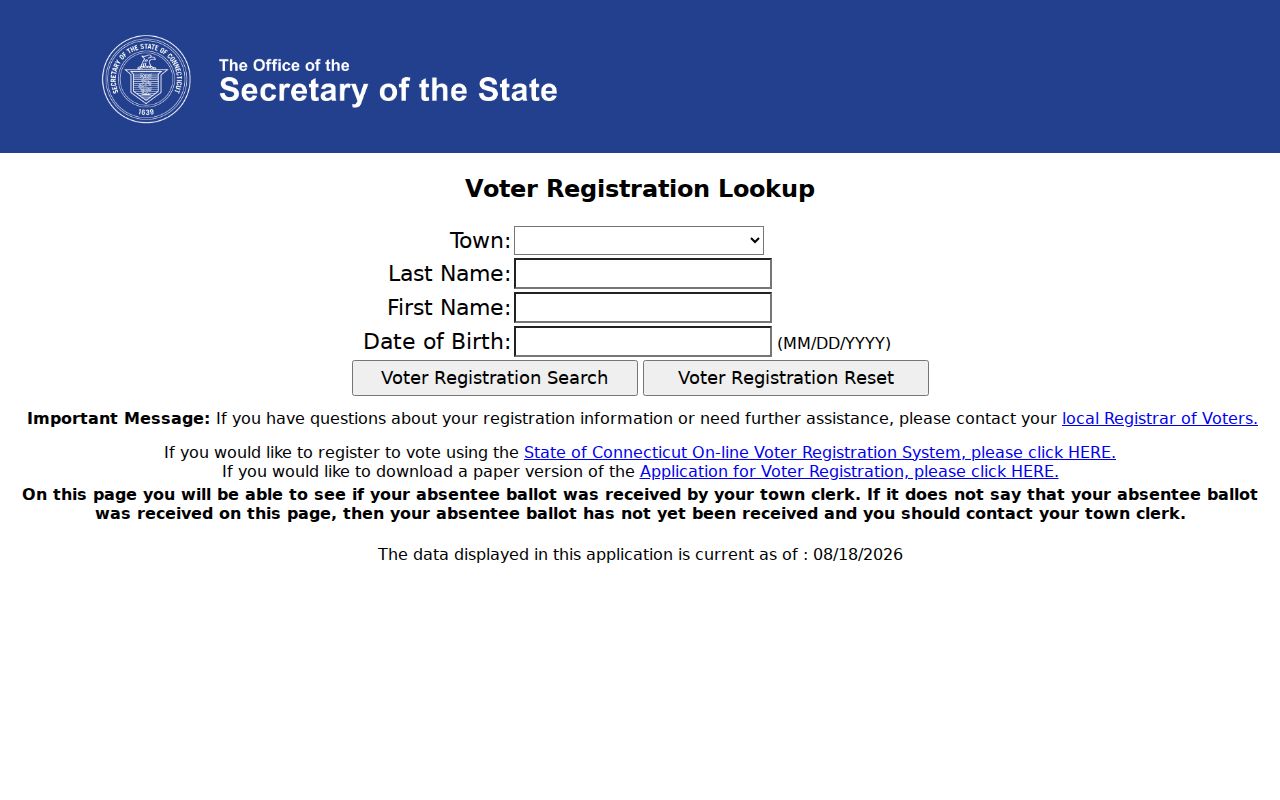
The official voter privacy program page explains why protected details may not look like an ordinary public address record.
Use the narrow record. New Milford records are appropriate for personal, lawful research. Do not use a name, address, or public-file result to stalk, harass, intimidate, or harm another person.
New Milford Court Record Routes
New Milford splits into two court routes. Civil matters belong to the Litchfield Judicial District, which now sits in Torrington. Estate and trust cases go to Housatonic Probate Court. That court is PD-44, at 47 Bridge Street in New Milford. The county label helps with venue. It does not create a countywide resident file.
On the civil side, the inquiry searches by party, docket, property address, and calendar. The property-address form needs a city or town. It takes a partial street plus a full five-digit ZIP. The same form filters by case type, property type, and active or disposed status. Coverage has limits. Foreclosure cases reach back only to January 1, 2014. Litchfield special summary-process matters reach back to January 1, 2017. Some records also carry public-access restrictions. The probate lookup, for its part, accepts estate or trust, district, status, and last or first name.
The Connecticut Judicial Branch civil inquiry provides the public court-search route.
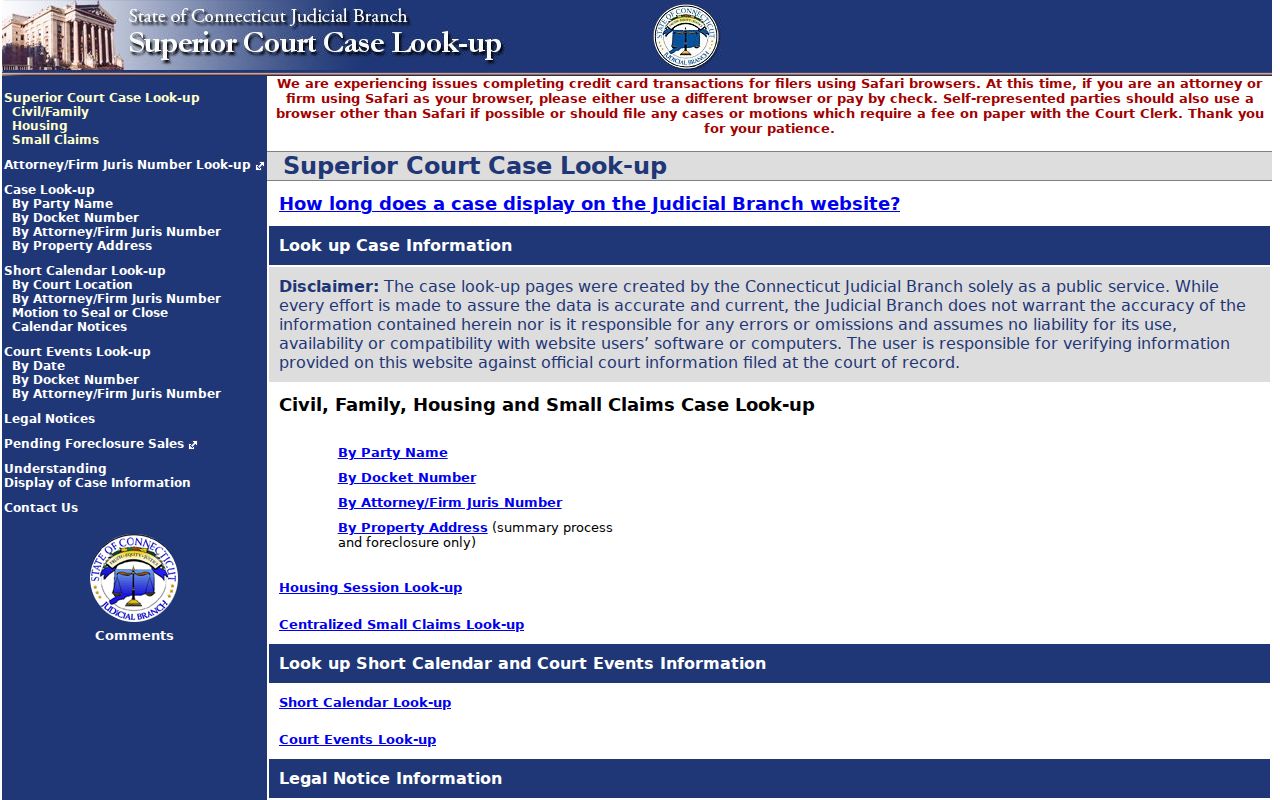
A Judicial Branch screen shows a public case display. It is never the official file itself. A party name can be a common-name match. A listed address may be a filing contact rather than a current home. The Housatonic Probate Court page identifies the local PD-44 route.
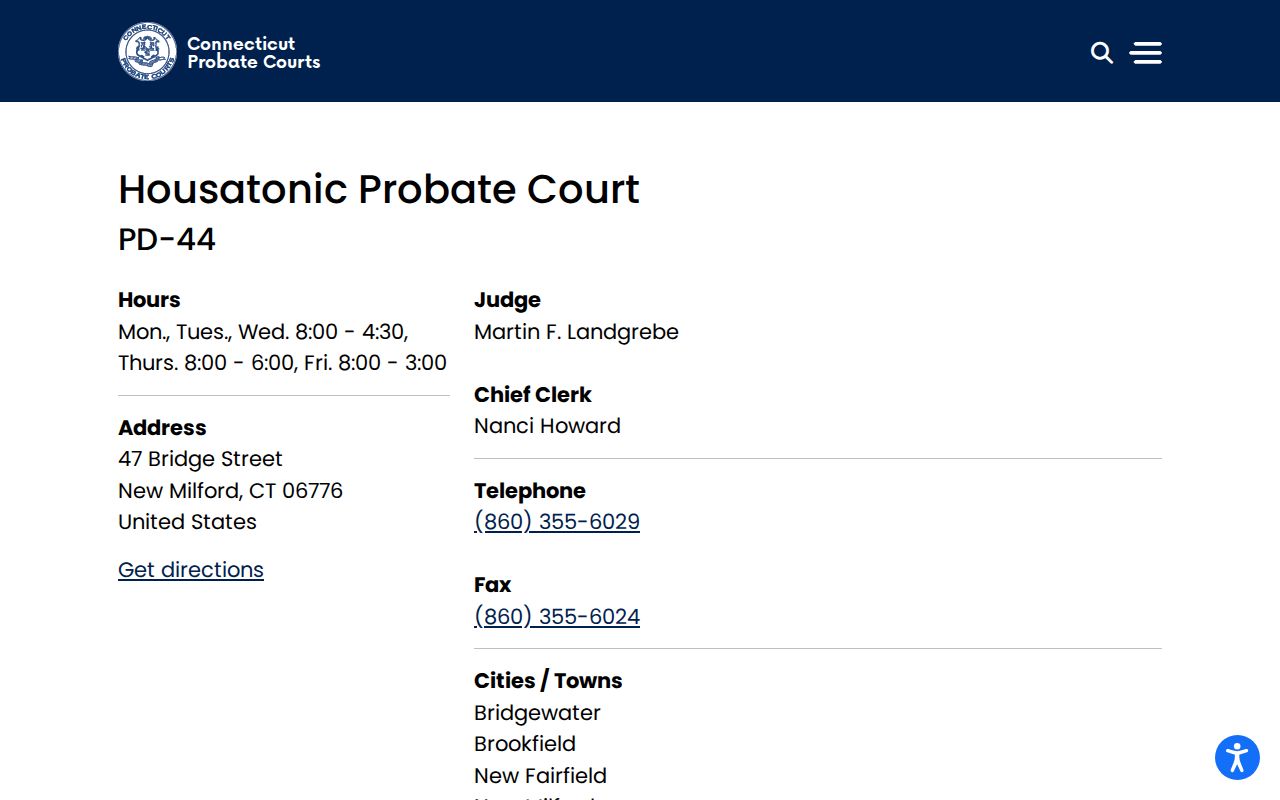
The Housatonic Probate case lookup can settle a case route and its status. For a document or certified record, court staff or the clerk are the next stop.
New Milford Vital Records Access
The Town Clerk issues New Milford birth, marriage, and death copies. The Connecticut Department of Public Health handles statewide guidance and forms. Birth records under 100 years carry restricted eligibility. Anyone 18 or older may buy a certified marriage or death record under state rules. Social Security numbers and other sensitive fields stay limited regardless.
Locally, the request route lists a $20 certified-copy fee, a photo-ID copy, and payment to the New Milford Town Clerk. Mail requests also require a self-addressed stamped envelope. State and town forms can differ, especially for birth copies and payment. DPH holds statewide records from July 1, 1897 forward. Its processing can take up to 12 weeks. A newspaper notice, directory entry, or family story may point to an event. Only the custodian issues the certified document.
The Connecticut vital records overview lays out the state and municipal record structure.
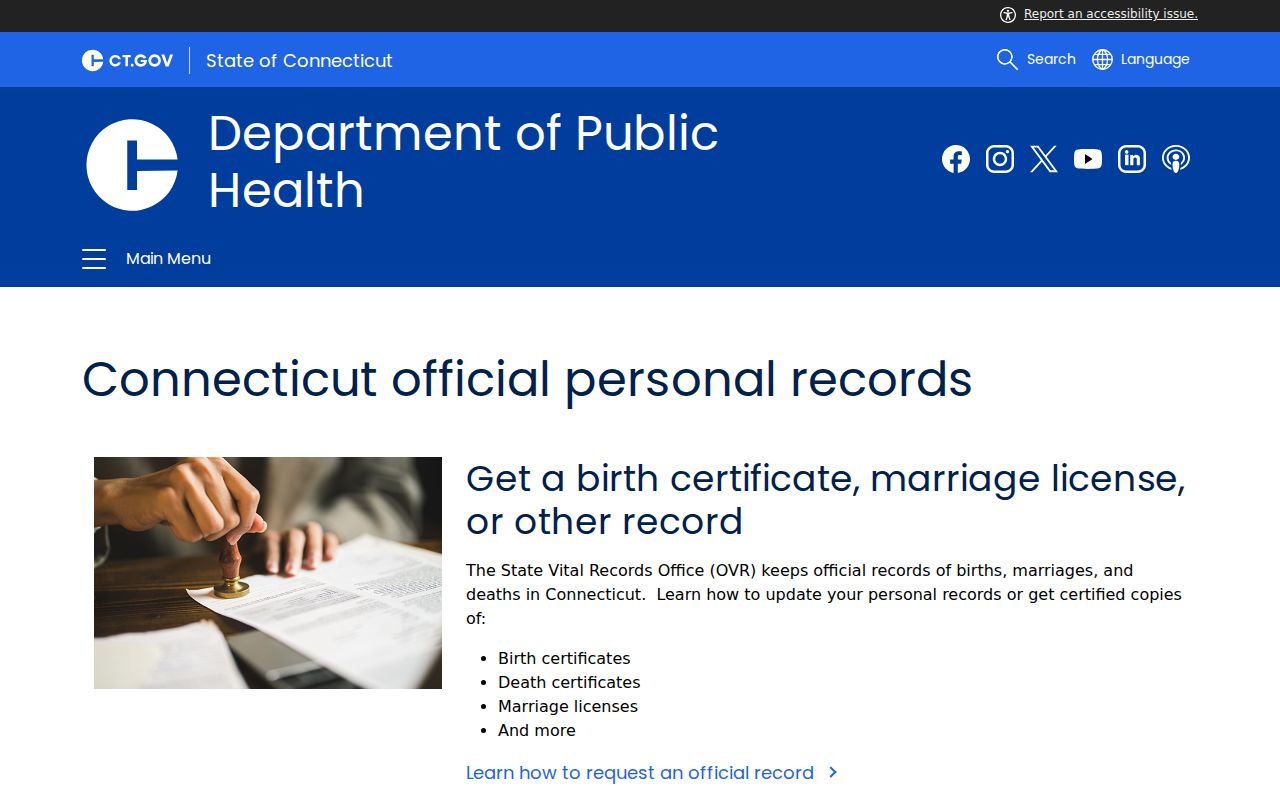
The state vital-record instructions explain ordering methods, eligibility, forms, and proof requirements.
| Birth under 100 years | Restricted requester group, ID, relationship proof, and form rules |
|---|---|
| Marriage | Certified access is broader, but Social Security information is limited |
| Death | Any person 18 or older may request; SSN access remains controlled |
| Historical records | Genealogical and statutory routes depend on date and custodian |
New Milford Civic Directory Geography
Place names do a lot of work in a New Milford search. The Village Center gathers the Green, Main Street, Bridge Street, Railroad Street, Town Hall, the Heritage Inn, and the Clifford Chapin railroad station. The Housatonic River and Candlewood Lake run throughout the town's planning and conservation material. Gaylordsville, Northville, Merryall, and Lanesville add village vocabulary. These names can surface in a newspaper, directory, polling record, or map.
Treat these labels with care. They are not interchangeable. A polling place is not a residence list. A village name is not always a postal city line. A map layer is not a legal boundary. The New Milford MapGeo viewer can help place an address and compare themes, while the Town Clerk holds the land-record evidence.
For revaluation figures, the New Milford tax assessor page is the office-level source. It also supplies property-search links.
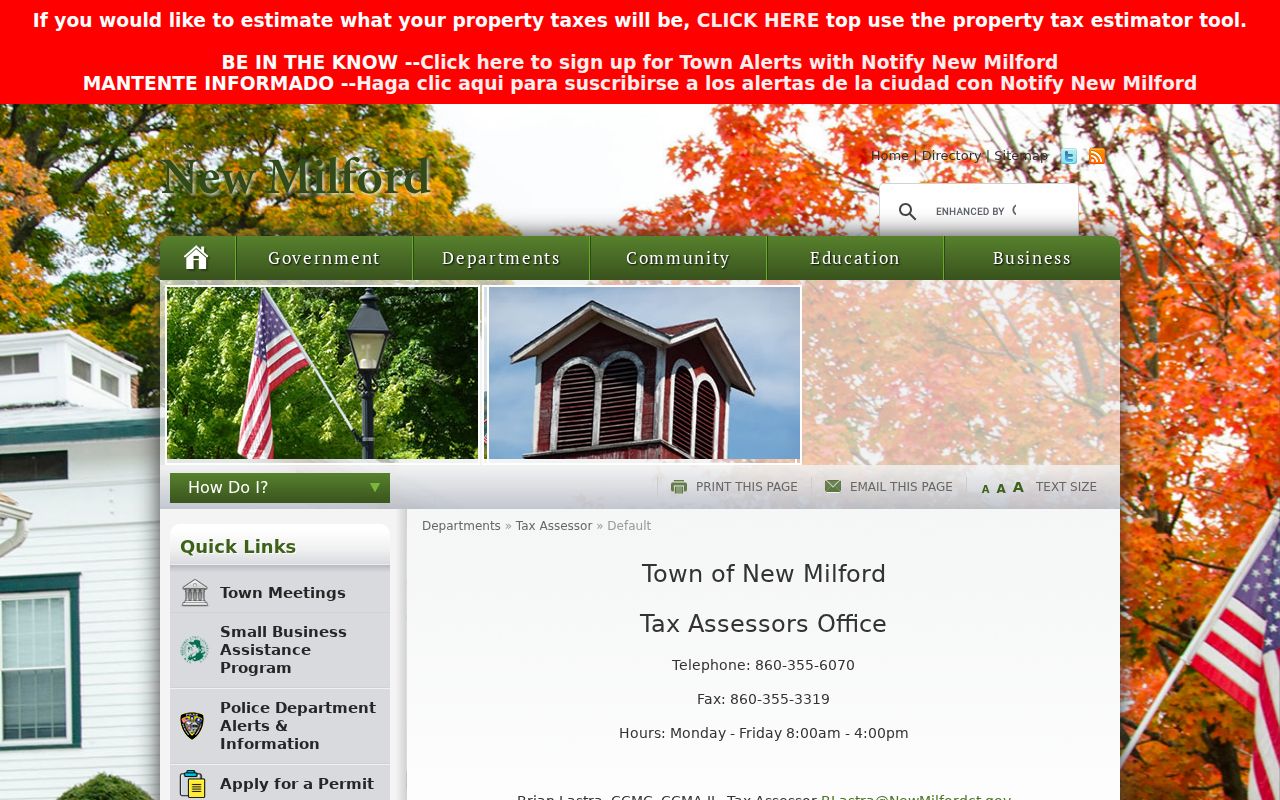
The assessor ties this civic geography to parcel identifiers. Even so, it reports a property record, not a complete household.
New Milford Records to Recheck
Current data in the New Milford residents directory carries a shelf life. Treat any figure as dated until the custodian confirms it. The assessor reports that the 2025 revaluation is complete. MapGeo's public configuration can change without notice. Voter privacy and access rules remain active policy questions. The Secretary of the State published a January 16, 2026 Q&A addressing a federal lawsuit that seeks broader statewide voter data. Fees, portal fields, polling details, and coverage notices can all move faster than historical collections do.
The Connecticut Treasurer's January 28, 2026 unclaimed-property notice reported more than $1 billion held, with $120.9 million returned to nearly 60,000 owners in fiscal year 2025. That official search checks a state-held asset. It is not a residents directory. Keep a publication date beside every timely fact. Return to the records office itself before relying on a number. The DPH vital-record ordering guide remains the statewide source for request guidance.
Recheck links and access rules before acting on any current New Milford record. That caution matters most when a result touches a protected person or a fee-based request to a records office.
Historical New Milford Directories
A historical residents directory turns a current address into a dated name-and-place question. The Bridgeport History Center lists New Milford editions for many years. Those years include 1927, 1950, 1960, 1966, 1969, 1971, 1974 through 1976, 1978, 1981, 1983, 1985, and 1987 through 1990. The Library of Congress holds New Milford telephone directories from 1961/62 through 1965/66. Regional editions there may also catch a New Milford entry.
Directory evidence is narrower than a present-day resident lookup. One entry can show a name, street line, occupation, business, or telephone address. That detail holds for a single edition. A map can name an owner or a building. A newspaper can place a person at an event. Pair those items with a parcel or deed date. Do this when the question concerns a specific house. Then turn to the New Milford city directory collections for the full dated-shelf method. The street directory of the past answers only the year it covers.
New Milford Historical Directory Research
The New Milford Public Library at 24 Main Street is the natural first stop. It helps with catalog, research, and reference questions. Its public pages publish no complete local directory. There is no obituary index and no microfilm inventory online either. Ask staff to confirm a title before assuming a shelf or scan exists. The Connecticut State Library offers a historical and genealogical guide, and its digital collection adds a statewide repository path for any resident lookup that outgrows the town.
The New Milford Historical Society reports more than 8,000 items. About 3,000 are cataloged online. Its holdings include three one-room schoolhouses and the 256-year-old Knapp House. A directed ancestor or family search gives the first half-hour free. Additional time bills at $25 per half-hour. Copies list at $0.25 and scans at $0.50. Those are research-service terms, not a promise that a particular person or house will appear. The New Milford FOI request route shows where a defined municipal records request begins.
When a shelf or portal comes up empty, ask the people who know the stacks. The New Milford Public Library, the Connecticut State Library, and the Historical Society can each identify the next documented source for a New Milford records question.
New Milford Map Record Trail
The 1853 Library of Congress map names selected owners. It also names buildings before Bridgewater separated from New Milford in 1856. Sanborn sheets identified for New Milford include 1887, 1892, 1897, 1904, and 1909. These dated images earn their keep. A street, village, building, or owner label may fail to line up with a modern PID.
Treat an old map as a bridge, not a roster. Start at the current Vision parcel. Compare the MapGeo location next. Follow the Town Clerk deed chain from there. Then match a Sanborn footprint or named-owner map to a directory or newspaper year. The 2002 town budget noted a plan to computerize older land-record index books. That plan included pre-1971 work. That history explains why an in-person index check still matters. A current portal may return no older hit at the records office.
New Milford Town Records and County
New Milford is legally a Connecticut town. Even so, this residents directory uses a city-style category. It was established in October 1712. Connecticut abolished county government on October 1, 1960, so Litchfield County has no county seat. Torrington hosts the Litchfield Judicial District courthouse. That makes it a court location, not a county seat. Housatonic Probate Court remains a New Milford court route for probate matters.
Boundary history also shapes older records. Bridgewater was taken from New Milford in May 1856. Brookfield was partly formed from New Milford land as well. A family or property record may cite an older jurisdiction. Preserve the original wording and date. Then translate it to a modern town name. That small step keeps a county label in check. The local record trail stays intact through the assessor and recorder.
Record the custodian. A trustworthy New Milford residents directory entry names the office, portal, edition, or map behind it and distinguishes a lead from a confirmed record.